Thursday, July 22, 2010

An 'Island' farewell for Oak Lawn

Cranston Herald
July 22, 2010
All text and photos by Jen Cowart

ISLAND SPIRIT: Anthony Heng, Sam Franco, Arianna Boscia, Matt Lonardo and Ryan Marsella played Jamaican music for the other students who visited the Island Bazaar.


The students in Patricia Ruggieri and Rosemary Reardon’s sixth grade classes bid farewell to the school year and hello to summer by hosting an Island Bazaar during the last week of school.


The idea came about when the staff and students realized that there were many unused products from their school store that were never opened during this school year. As they tried to decide what to do with all of the merchandise, the idea for the Island Bazaar began to take shape.

“We had difficulty starting up with the school store, and then we had no place to open, and no good time to have it. We decided to do this instead,” said Reardon.

The students realized that although they had a great deal of merchandise to sell, more was still needed in order to market their bazaar to the entire school. They decided to make things to sell.

Bookmarks, hair accessories, origami flowers and pins made the list and the students began outlining a plan for when they would make their creations.

“We set up a schedule where they would work very hard and focus in the morning and then make their crafts and get ready for their production in the afternoon,” said Reardon. “They were even making origami flowers during their lunch.”

Every grade visited the bazaar to a set schedule. Each visiting class was treated to Jamaican music, games, relays, and even got the chance to learn the musical instruments.

Retiring music teacher Jean Green had been teaching the sixth graders some Jamaican music to go along with the play “The Cat and a Rat,” as part of an end of the year unit of study. They were also learning how to perform using several musical instruments, such as the bass xylophone, in conjunction with the songs for the play.

“We made enough money to give our volunteers all a gift, give a sixth grade gift to our school, and pay off our school store bill,” said Reardon.

What began as a solution to one problem became a huge success in the eyes of the sixth graders and their teachers.

“This has been great. They loved it,” Reardon said.

Peters School remembers Ms. Rankin

Cranston Herald
July 22, 2010
All text and photos by Jen Cowart


REMEMBERING MS. RANKIN: Principal Patricia Caporelli explains that just as Meg Rankin had an effect on the future, so too would her memorial tree spread its branches far and wide for many years.


Margaret “Meg” Rankin, a teacher at George J. Peters Elementary School, lost her battle with cancer this past April.


But thanks to the staff, students and families of the Peters community, she won’t soon be forgotten.

At a ceremony last month, Principal Patricia Caporelli hosted a ceremony to celebrate Rankin’s life and commitment to education in Cranston. Rankin’s mother, Nancy Scarton, had traveled to Rhode Island for the memorial ceremony.

“We are truly honored to have you here to help us celebrate the life and memory of a special faculty member,” said Caporelli. “This is a bittersweet celebration because we all wish she were here with us.”

She introduced Patricia Bennett’s second grade class, who read a class letter, “Dear Meg Rankin’s Mom,” with each child reading a part of the letter. They said they thought Scarton would enjoy hearing some of the special things about her daughter, which included her smiling face when she entered their classroom, and a book about homonyms that she shared with them one day.

Four students from Rankin’s fourth grade class shared memories of their beloved teacher, describing her as kind, incredible, nice and spectacular.

“Ms. Rankin was a very good teacher. She was kind and nice and helpful. My favorite memory of her was when we made gingerbread houses,” said Lexie Freeman. “I will miss her but I am thankful that I have such happy memories of her.”

Fifth grader Brittany Tougas read a poem aloud to the audience.

“Ms. Rankin took you through miles and miles of challenges, even though she had the biggest challenge of her own to face,” Tougas said. “A part of her will always remain with us.”

Tougas’ poem was followed by the fifth grade chorus performing an emotional rendition of, “I Have a Dream.”

Faculty member and friend of Rankin, Patricia Bennett, presented Scarton with Rankin’s yearbook, which she had purchased earlier in the school year. It was filled with messages from the staff and teachers at Peters. She invited anyone else to add a message as well.

The ceremony moved outside, where a Weeping Cherry Tree donated by Briden Nursery was planted in the yard of the school. The George J. Peters Sunshine Committee, along with the students at Peters, donated a bench to accompany the tree.

J. DiMarco Landscape donated flowers to be planted around the tree, and the Cranston Teachers Alliance 30 Week Club donated a memorial plaque for the bench.

The students and faculty, family and friends surrounded the perimeter of the area in which the tree was being planted as Caporelli continued the ceremony.

“Someone once said that the best time to plant a tree is 20 years ago,” said Caporelli. “The second best time is today.”

She stated that every action today has an effect on the future, and that Rankin had touched the future of so many students.

“For many years, this tree will spread its branches wide in memory of Ms. Meg Rankin,” Caporelli said.

Although it had been a cloudy, rainy morning, the sun shone brightly for the tree planting ceremony.

“Meg would not have had it any other way,” Scarton said as she thanked everyone for their support and for being a part of Rankin’s life.

Rankin’s family members and the students and staff were asked to come forward if they wanted to help lay the dirt around the tree, and many did step forward.

Bennett read a personal letter about her friendship with Rankin and all of the things she’d learned from her. Although Rankin was fighting her own battles, Bennett said she always asked what she could do to help others.

Scarton reminded the students how much her daughter had loved them.

“Meg was not married and did not have any children of her own, but you were all her children and she loved each and every one of you as an individual,” she said.

Thursday, July 15, 2010

Native garden in full bloom at Western Hills

July 15, 2010
Cranston Herald
All text and photos by Jen Cowart


TEAM EFFORT: After studying native plants during the school year, the students in Kelley Oelofse’s eighth grade science classes came out in droves to help plant the new garden at the school. They were assisted that day by Paul Dolan of the DEM and Cheryl Cadwell of the Rhode Island Wild Plant Society.


Thanks to the students in Kelley Oelofse’s eighth grade science classes this past school year, Western Hills Middle School has a new kind of classroom.


Oelofse, a garden-lover since childhood, teaches astronomy, physics and earth science at WHMS, but brought botany into her curriculum as well when she helped her class create a native garden that doubles as an outdoor classroom.

She began eyeing the perfect spot for the garden early last year. Located to the right of the school’s main entrance, it was barren and bare.

“There was absolutely nothing here, it was a vacant spot and everyone sees it when they pull up,” Oelofse said. “The soil is harsh but there is good light.”

Oelofse approached Principal Anthony Corrente about putting a native garden there and she found her boss to be very receptive.

“A native garden is so educational,” she said, explaining that native gardens only house plants native to the area, its climate, bugs and animals.

She gave an example of the Lunar Moth, which is a native bug. She explained that native bugs only eat native plants and native animals will eat native bugs. By removing the native plants, it creates a domino effect in the area.

Oelofse and her team of eighth-graders were on a mission to stop the domino effect, beginning at their own school.

“We’re just trying to stop a little bit of it and help a little bit,” she said.

Oelofse’s students, who would soon be off to high school, were happy to be a part of the solution rather than the problem when it came time to leaving their mark on Western Hills.

In order to bring a little bit of botany into her students’ curriculum, Oelofse had the students begin researching plants that were native to Rhode Island and its climate.

"They did pop-up book reports and every student did a different plant,” she said. “We found that we’ve actually destroyed more native habitat and plants in the United States than in the rainforest, and we’ve replaced them with aggressive and invasive alien plants which take over.”

Student Alyssa Ruggieri believes the project will be something future classes can participate in.

“I’m very glad that we’re doing this. We needed a change at our school to make it look better and this project is one that will just keep growing,” she said.

When all of the research was done, and it came time to create the actual garden, Oelofse had the help and support of her principal, the manual labor from her students, and lots of other outside support as well.

“Some of the parents said they’d donate benches,” Oelofse said. “Last year we got a small grant from the Wild Plant Society and this year we got an Earth Day Grant from DEM.”

The Wild Plant Society’s former president, Cheryl Cadwell, was on hand to help out when all of the planting began.

“Kelley did a wonderful job of introducing the kids to the native plants,” Cadwell said. “I love when teachers have this kind of energy and drive. I love how good this looks. There can’t be a better way to get kids to learn.”

Oelofse said that her students already want to do so much more during next school year.

“English classes can come out and write about what they see,” she said. “It’ll be a place where you can meander. It will have a lot of history too.”

NEL/CPS students stand out statewide

Cranston Herald
July 15, 2010
All photos and text by Jen Cowart


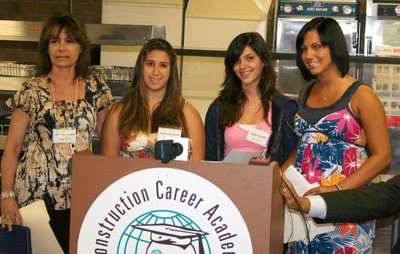
TOPS IN THE STATE: Tenth grade English teacher Marianne Capobianco poses with three award winning essay writers, Nicole Conti, Taylor Casale and Stephanie Casale.


With Oprah by his side, author Elie Wiesel challenged high school students across the country to write their own interpretations of his novel, “Night.”


Last month, the tenth graders from Marianne Capobianco’s class at NEL/CPS Construction Career Academy came out on top in Rhode Island.

“Night” is based on Wiesel’s experiences as a young Orthodox Jew, who was sent with his family to the German concentration camps at Auschwitz and Buchenwald during World War II.

“The students wrote essays about how the novel is still relevant today, approximately 65 years after World War II and the Holocaust,” explained Capobianco.

According to her, the students had to include such topics as racism, prejudice, bullying and stereotyping in their work.

The top three finalists in the essay contest were first place: Nicole Conti, second place: Taylor Casale and third place: Stephanie Casale. Each student received cash prizes and was recognized at the school’s Project Day in front of Mayor Allan Fung, Superintendent Peter Nero, and many other dignitaries from the Laborers’ Union, the City of Cranston, and Cranston Public Schools.

“Out of 48 essays, the top three finalists were from here. That’s incredible,” said Capobianco.

Also on Project Day, Eugenia Marks, senior director of Policy from the Audobon Society, presented senior Kayla LaFerriere with a first place prize of $50 for winning first place in an essay contest sponsored by the Audobon Society of Rhode Island.

Centering on Earth Day, LaFerriere’s essay discussed what the barriers were to bicycling and walking in her community, which is Pawtucket. She wrote in her essay about ways to travel that would help save the environment. The contest was open to all high school seniors across the state.

“Although Kayla wrote about her hometown of Pawtucket, her essay was relevant to communities all over Rhode Island,” said Marks.

Capobianco was proud of her students’ accomplishments during this school year, but was especially proud of what they learned and what they in turn, taught others through their written work and their classroom discussions.

"These students actually taught me this year. I learned from their questions, their comments and their insights,” she said.

Cranston leads the way to green

Cranston Herald
July 15, 2010

Two Cranston residents were recognized individually for their work with the environment recently. Steven Stycos and Karen Verrengia each received a 2010 Environmental Merit Award in Boston.


According to the EPA, the merit awards recognize individuals and groups whose work has protected or improved the region’s environment in distinct ways.

The awards, which were established in 1970, were given out in conjunction with the fortieth anniversary of Earth Day.

“Today, on this milestone anniversary of Earth Day, I’d like to acknowledge and honor people, communities and businesses that have made significant strides in protecting New England’s health,” said Curt Spalding, regional administrator of EPA New England.

Spalding noted, during ceremonies to honor the winners, that President Obama issued an Earth Day challenge to Americans to take action – in homes, in the community and in schools or businesses, to improve the environment.

“I really didn’t understand just how big this was,” said Verrengia, who is the Energy Manager for the Cranston Public Schools. “I almost didn’t go, then at the last minute, I called and I went. I’m so glad I did.”

There were several different types of awards given, including the individual merit awards that Stycos and Verrengia received, as well as group awards and lifetime awards.

Although Stycos is known for his work on the Cranston School Committee, his other passions include protecting the Pawtuxet River and supporting Rhode Island Farmers.

He currently serves as the president of the West Bay Land Trust. He created and maintains a network of walking trails and offers canoe rides and nature walks to the public. He founded Friends of the Pawtuxet in 1982 and is still a leader of the organization. He also helped to launch and still coordinates the Pawtuxet Village Farmer’s Market.

Stycos is responsible for connecting the Cranston Public Schools with local farmers so that students purchasing school lunches are eating locally produced, farm-fresh foods during the school year.

“The Farmer’s Market is held at Rhodes-on-the-Pawtuxet each weekend from May to November and has been going on for eight years,” he explained.

Stycos said that, like Verrengia, he was surprised to find out that he’d been nominated for an award.

“It was fun though, to see what other people [receiving awards] were doing. They were all doing their little piece and there were some very creative ideas,” he said.

Stycos said that he was pleased to see Verrengia recognized for her work. As the CPS Energy Manager, Verrengia has worked tirelessly to make the school buildings more energy efficient, and started from scratch when she took on the job.

“I was glad to see Karen get recognized,” he said. “It was a bit of a push to get the district to recognize the energy issues, but now it’s really taken off.” Verrengia agreed.

“There are people all around the country tracking us now. People are really starting to look and pay attention not just to our program, but to the environment. It took two to three generations to get into this and now it’ll take 10 years or more to pick up the pieces,” she said.

Verrengia was nominated by someone she’d never even met from the EPA of Rhode Island. Stycos was nominated by Peyton Flemming, with whom he started the Farmer’s Market.

“He didn’t tell me he was nominating me, but he kept calling and asking for my wife. I didn’t know why though, until I got the e-mail,” he said.

Verrengia said it was quite the experience attending the event, which was held in Faneuil Hall in Boston.

“It was all very inspiring: the building, the history, the people,” she said.

Verrengia and Stycos said that at the ceremony itself, each person was individually recognized and the letters of nomination were read.

“It was exciting to see all the letters that were written,” Verrengia said. “When you’re working and doing your work every day, it seems so incidental. Or, if you ask to do something bigger, it seems like nickels and dimes [that would be saved] but it really does add up.”